Harnessing AI for the Bioeconomy, Part 3: Smarter Biobased Supply Chains
Dr Konstantinos Drousiotis
Senior Research Analyst

Biobased products – including biofuels, biomethane, biochemicals, bioplastics, natural-fibre materials and bio-based coatings – are central to the transition from fossil-based production to a circular bioeconomy. However, commercialising these products at scale depends not only on efficient process technologies but also on the effectiveness of their supply chains. Biomass must be sourced, characterised, collected, transported, processed, distributed and, where possible, recovered or reused. This article looks at current thinking on how artificial intelligence (AI) can transform the sourcing, logistics, processing and traceability of biobased value chains, while also examining the barriers that constrain adoption and the conditions under which AI genuinely delivers sustainability benefits.
Why biobased supply chains are different
Biobased supply chains face conditions that conventional planning tools, designed for stable, uniform fossil inputs, handle poorly. Feedstocks such as agricultural residues, energy crops, forestry and food waste, and manure can vary significantly in volume and quality with weather, geography and season, while moisture, ash, lignin, calorific value and biochemical potential can differ between batches and fields. Thousands of small suppliers feed a few large biorefineries, creating coordination challenges, and many feedstocks are perishable and low‑density, so transport costs and spoilage can dominate economics and erode climate benefits. At the same time, certification schemes and regulations (ISCC, USDA BioPreferred, EUDR, CSRD) demand robust chain‑of‑custody and granular carbon accounting, and biorefineries and digesters operate within tight biochemical windows where feedstock variability can destabilise yields or cause process failure11 European Commission. (n.d.). Bioeconomy Strategy. Environment. https://environment.ec.europa.eu/strategy/bioeconomy-strategy_en,22 Sustainable Biofeedstock Supply Chains for Advanced Biofuels in Europe towards 2050. (2025). Concawe / Advanced BioFuels USA. (Figure 1).
A major review of AI in bioenergy confirms that feedstock variability, conversion economics and supply-chain reliability are precisely the barriers limiting large-scale deployment of biomass-based products iii. AI – encompassing machine learning, computer vision, optimisation algorithms, digital twins and natural-language systems – excels at extracting patterns from exactly this kind of heterogeneous, high-volume, uncertain data.
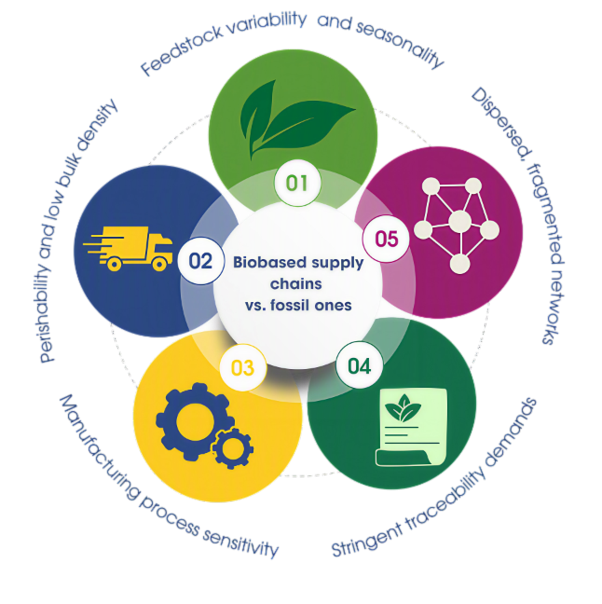
Figure 1
Upstream: AI-driven feedstock forecasting, sourcing, and quality grading
The greatest uncertainty in a biobased value chain sits at the biomass source. Machine-learning models integrating satellite imagery (e.g., Sentinel data), weather forecasts, crop statistics and historical yields can predict biomass availability and composition weeks or months ahead. Convolutional neural networks (CNN) and long short-term memory (LSTM) architectures identify spatial and seasonal patterns that can signal lower-than-expected yields, delayed or earlier-than-planned harvests, and localised supply shortfalls 34 Gonzalez J, Wang J. Optimising biomass feedstock logistics using AI for integrated multimodal transport in bioenergy and bioproduct systems: a review. Logistics. 2026;10(3):54,45 El Sakka, M., Ivanovici, M., Chaari, L. and Mothe, J. (2025) ‘A review of CNN applications in smart agriculture using multimodal data’, Sensors, 25(2), art. no. 472. doi: 10.3390/s25020472.. For example, a CNN-LSTM model using MODIS satellite data in Senegal reduced maize yield-prediction error by 59% through transfer learning from neighbouring countries56 Omdena / Global Partnership for Sustainable Development Data. Improving food security and crop yield through machine learning (Senegal maize yield project).. Critically, forecasts only become commercially useful when linked to optimisation models that recommend sourcing, blending and investment decisions – predictive AI alone is not enough. Near-infrared spectroscopy paired with machine-learning classifiers enables rapid, automated grading of incoming biomass at intake, rejecting contaminated or degraded loads before they incur processing costs, and image-recognition systems have achieved up to 90% accuracy in feedstock classification 67Egbuna IK, et al. Application of artificial intelligence in bioenergy supply chain management from feedstock collection to power generation. World Journal of Advanced Engineering Technology and Sciences. 2025;16(02):141–153. (Figure 2).
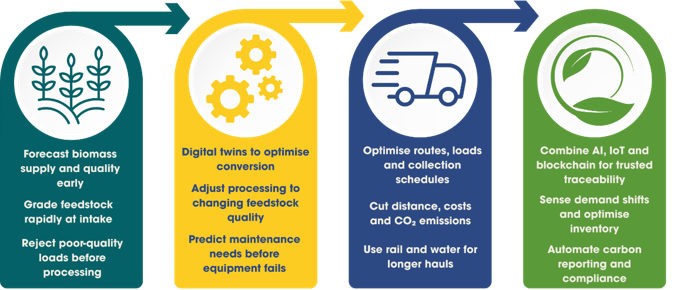
Figure 2
AI‑assisted logistics and smart bioprocessing
Biomass logistics are expensive precisely because feedstocks are bulky and dispersed. AI-driven route optimisation, load matching, collection scheduling and multimodal planning can materially cut cost and emissions; reviews report that genetic-algorithm-based network design has achieved a 25% reduction in travel time, 30% fewer stockouts and 15% lower operating costs, while a hybrid “green AI” model combining geospatial data with multi-objective optimisation achieved a 27% reduction in total distance, operating costs and CO₂ emissions when tested in real-world supply chain routes 78Real-world evaluation of hybrid Green AI for sustainable and efficient smart supply chain distribution. Scientific Reports. 2026.. Truck transport suits short distances; coordinated rail and water transport, enabled by AI optimisation, reduces costs and greenhouse-gas emissions over longer hauls.
Inside facilities, digital twins – virtual replicas of reactors and conversion units combining mechanistic models with neural networks – use “soft sensors” such as pH, temperature, dissolved oxygen, CO2 evolution and older data, to infer hard‑to‑measure variables (microbial density, metabolite accumulation) from basic process signals, and automatically adjust pH, temperature, enzyme dosing and retention times as feedstock composition varies89A review of artificial intelligence applications for biorefineries and bioprocessing. Processes. 2025;13(8):2544.,910 Digital Twins to Advance Biomanufacturing. Predictive maintenance models analyse vibration, thermal and acoustic telemetry to schedule repairs before failure, and AI inventory and blending optimisation handles feedstock uncertainty far better than deterministic models; in one study, a custom heuristic algorithm solved a complex biomass supply-chain problem in just 140 seconds, compared to three hours using a standard commercial optimisation solver. Reported operational gains include overall biofuel yield increases of 15–25% from predictive process models, with targeted deep reinforcement learning models specifically boosting ethanol yields by 12–15%, and predictive maintenance cutting unplanned plant downtime by 20–30%.
Downstream: demand, distribution and circularity
The full potential of AI in biobased supply chains is realised through integration with complementary digital technologies. Hybrid blockchain-AI-IoT frameworks are enabling low-cost digital monitoring, reporting, and verification (MRV) in sustainable bioethanol supply chains. One pilot framework demonstrated high-performance tracking capable of processing 1,960 data transactions per second with sub-second verification, reducing smart-contract computing costs (gas) by 12 million units, and validating regulatory compliance in under 2.1 seconds. Economic analysis yielded a mean return on investment of 20% and a five-year net present value of approximately USD 71,000 over initial system deployment and integration costs. IoT and blockchain integration have been shown to cut supply chain losses by 22% and improve life cycle assessment carbon accounting accuracy by 32%1011 Nori, I., et al. A hybrid blockchain–AI–IoT framework for low-cost digital MRV in sustainable bioethanol supply chains. ScienceDirect, 2026..
Upstream supply chain optimisation is only effective if downstream market demand can be accurately anticipated. Machine-learning demand-sensing models that incorporate regulatory shifts, carbon pricing and market trends allow producers of biologically constrained products to align variable production with fluctuating demand – forecasting accuracy improvements of 25–40% are reported, with major inventory-cost implications1112From Historical Data to Predictive Insights: the Next Era of Forecasting,1213 JMSR (2025). The Impact of AI-Based Demand Sensing on Inventory Optimisation and Bullwhip Effect Mitigation.
AI can also help to increase circularity in material flows, improving the recycling of products at their end-of-life. For biobased packaging or composites, computer vision and material-recognition systems could identify products or contaminants in sorting operations. In logistics, AI routing engines can account for spoilage rates, refrigeration load and humidity to preserve material integrity in transit. Predictive models could estimate product lifetime, likely return volumes or the most suitable end-of-life route1314 MDPI Algorithms (2025). Machine Learning in Reverse Logistics: A Systematic Literature Review. Machine Learning in Reverse Logistics: A Systematic Literature Review, 1415 Academia.edu (2026). Smart cold chains for food systems: IoT monitoring and predictive quality management (Figure 2).
Challenges and barriers to adoption
Despite its transformative potential, AI adoption in biobased supply chains faces significant barriers. Data-related challenges – scarcity, quality issues, and limited availability – constrain model development and generalisation. Interoperability problems persist across different systems and data sources. The “siloed” nature of existing models and data limits the development of truly integrated solutions.
Technical and operational barriers include model reliability and generalisability issues, scalability challenges, and significant computational requirements. Economic hurdles, high implementation costs, particularly for small and medium enterprises, remain substantial. Furthermore, AI’s own computational resource demands raise sustainability questions about its environmental footprint. Skills gaps and governance challenges further complicate widespread adoption1516 Dhamija, P. and Bag, S. (2020) ‘Role of artificial intelligence in operations management: a review and bibliometric analysis’, The TQM Journal, 32(4), pp. 869–896..
Transparency is equally important. Decision-makers need to understand the assumptions, data limitations and uncertainty behind AI-generated recommendations. This is especially relevant for sustainability claims, where a company must be able to explain the basis for reported carbon reductions and avoid overstating benefits. Human oversight, independent verification and clearly defined performance metrics are essential1617 Rai, A. (2020) ‘Explainable AI: From prediction to understanding and trust’, Journal of the Academy of Marketing Science, 48(1), pp. 137–141.

Conclusion
Artificial intelligence represents a critical enabler of the circular bioeconomy transition—from precision agriculture and feedstock sourcing through logistics optimisation, conversion efficiency, and end-use demand management. The integration of AI with IoT, blockchain, and digital twins creates powerful platforms for traceability, transparency, and sustainability verification.
Yet this promise must be weighed against implementation challenges: data limitations, economic barriers, skills gaps, and AI’s own environmental footprint. The future of sustainable biobased supply chains will depend on the convergence of biological innovation, AI, and economic feasibility rather than isolated technological advances. Continued research, investment, and cross-sector collaboration are essential to fully harness AI’s potential for a sustainable, low-carbon bioeconomy aligned with global climate goals.