Harnessing AI for the Bioeconomy, Part 1: From Field to Biorefinery
Dr Konstantinos Drousiotis
Senior Research Analyst
In the first of a series of three articles, Senior Research Analyst Dr Konstantinos Drousiotis takes a look at how artificial intelligence is shaping the bioeconomy, in particular how crops are bred, monitored, managed, and delivered.
Artificial intelligence is emerging as a critical contributor to this, offering predictive, adaptive, and autonomous capabilities that bridge the gap between agricultural fields and industrial biorefineries.
Introduction
The global transition toward a circular bioeconomy is reshaping how society produces energy, materials, and chemicals. Biobased products – ranging from biofuels and plastics to cosmetics and pharmaceuticals – offer a renewable alternative to fossil-derived resources, yet their commercial viability hinges on the reliability, cost-effectiveness, and sustainable supply of biomass feedstocks11 Liao, K., & Yao, Y. (2021). Machine learning in biomass biorefineries: A review. Renewable and Sustainable Energy Reviews, 145, 111157.. Many of the most important feedstocks, such as maize, wheat and sugarcane, are dual-use crops grown for both food and industrial use, while dedicated energy crops such as sorghum and miscanthus are bred specifically for biomass quality and yield. Crop production for biobased industries must satisfy both agronomic and industrial criteria: high and stable yields, predictable harvest windows, consistent moisture and impurity levels, and, for lignocellulosic feedstocks, specific traits such as lignin-to-cellulose ratios that influence conversion efficiency22 Cosgun, A., Günay, M. E., & Yildirim, R. (2023). A critical review of machine learning for lignocellulosic ethanol production via fermentation route. Biofuel Research Journal, 10(2), 1859–1875. https://doi.org/10.18331/BRJ2023.10.2.5. Meeting these demands at scale requires more than incremental improvements in agronomy; it demands a paradigm shift in how crops are bred, monitored, managed, and delivered. Artificial intelligence (AI) is emerging as the critical contributor to this shift, offering predictive, adaptive, and autonomous capabilities that bridge the gap between agricultural fields and industrial biorefineries.
Smarter breeding: using AI to grow better crops for energy and industry
The slowest constraint in feedstock supply is biological. Dedicated energy and industry crops have received a fraction of the breeding investment given to food staples, and many industrially relevant traits – cell-wall composition, oil profile, lodging resistance – are laborious to measure. Genomic selection changes this calculus: machine-learning models predict breeding values from genome-wide markers, allowing each cycle to evaluate loads more candidates than could be grown to harvest. For high‑biomass sorghum, predictive models have demonstrated useful accuracy for fibre content, lignin and dry matter yield, enabling breeders to select superior genotypes in early generations33 Chang, Y., Ni, Z., Panelo, J.S., Kemp, J., Salas-Fernandez, M.G. and Wang, L. (2025) ‘A data-driven crop model for biomass sorghum growth process simulation’, Frontiers in Plant Science, 16, p. 1617775. doi: 10.3389/fpls.2025.1617775. . Projects such as Miscanthus AI at Aberystwyth University treat the breeding pipeline itself as an integrated AI system, combining image-based phenotyping with genomic prediction to select for net-zero-relevant biomass traits such as high biomass yield, suitability for marginal land, low input requirements, perennial growth habit, drought/frost/flood tolerance, strong carbon sequestration, etc44 http://www.miscanthusbreeding.org/miscanspeed.html.
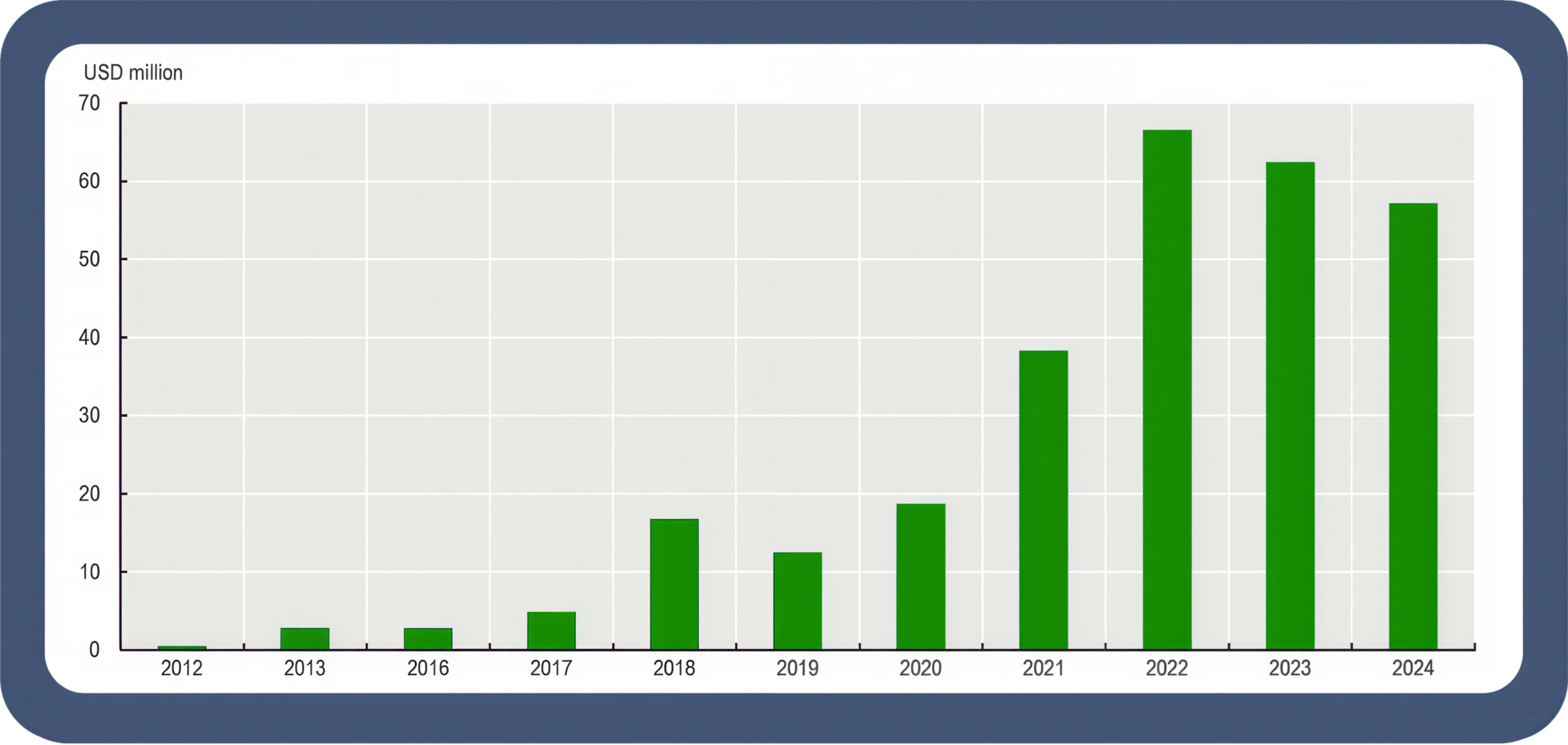
This acceleration matters because biorefineries need feedstock of predictable quality. In EU alone, the venture capital investments in AI-driven, agri-tech start-ups have almost quadrupled within period 2018 – 2024 (Figure 1).
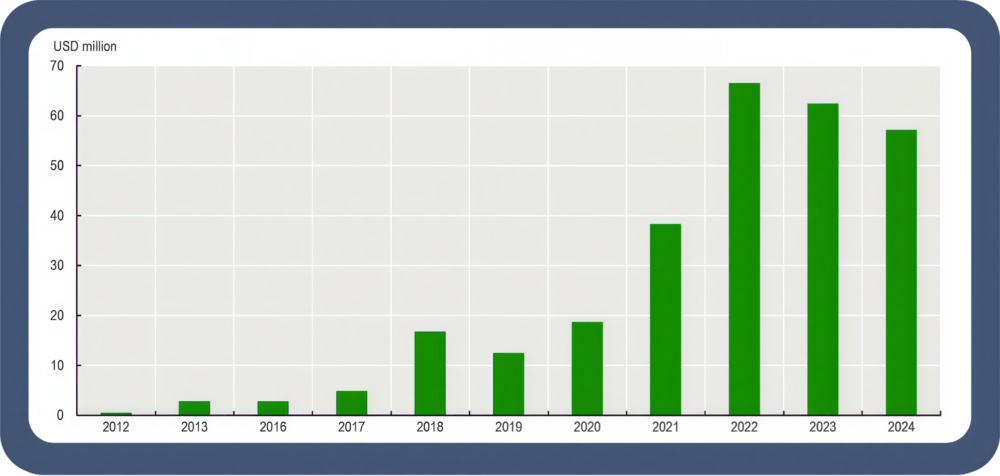
Figure 1
Figure 1. Venture capital investments in AI-driven, agri-tech start-ups in the European Union
Near-infrared (NIR) and FTIR spectroscopic data, processed through machine learning algorithms, increasingly enable rapid, non-destructive estimation of cellulose, hemicellulose, and lignin content, offering a much faster alternative to traditional wet-chemistry analysis. Commercial laboratories such as Celignis have built NIR prediction models spanning a wide range of lignocellulosic feedstocks – including miscanthus and other biomass crops – by training on large sample sets that capture variation in plant variety, growing conditions, and region, which helps make the models broadly applicable across different biomass types55 https://www.celignis.com/NIRanalysis.php.
The industrial payoff extends to processing itself. In the sustainable aviation fuel sector, the Joint BioEnergy Institute demonstrated that integrating AI to predict the ideal blend of miscanthus and sorghum improved conversion efficiency by 15% while reducing carbon emissions by 10% (IJARCS, 2024). Neste, a leading SAF producer, deployed AI predictive analytics to forecast optimal feedstock availability across multiple regions, cutting procurement costs by 15% and improving delivery efficiency by 12%66 Luman, R. (2025) ‘AI-powered feedstock optimization in sustainable aviation fuel production: Enhancing efficiency and reducing costs’, International Journal of Advanced Research in Computer Science, 16(5).. Benson Hill (a U.S. ag-tech company) operates an industrial-scale AI breeding platform called CropOS that is actively developing soybean varieties tailored for biofuels. Since 2021, CropOS has designed and advanced more than 24,000 candidate varieties, using billions of data points to inform predictive breeding. Their “dual value beans” – varieties optimised simultaneously for feed and improved oil for the biofuels market – are advancing rapidly, and their third-generation ultra-high-protein lines have closed the yield gap with commodity GMO soybeans to just 3–5 bushels per acre while delivering a 2% protein gain77 https://www.world-grain.com/articles/19467-benson-hill-advances-soybean-seed-portfolio.
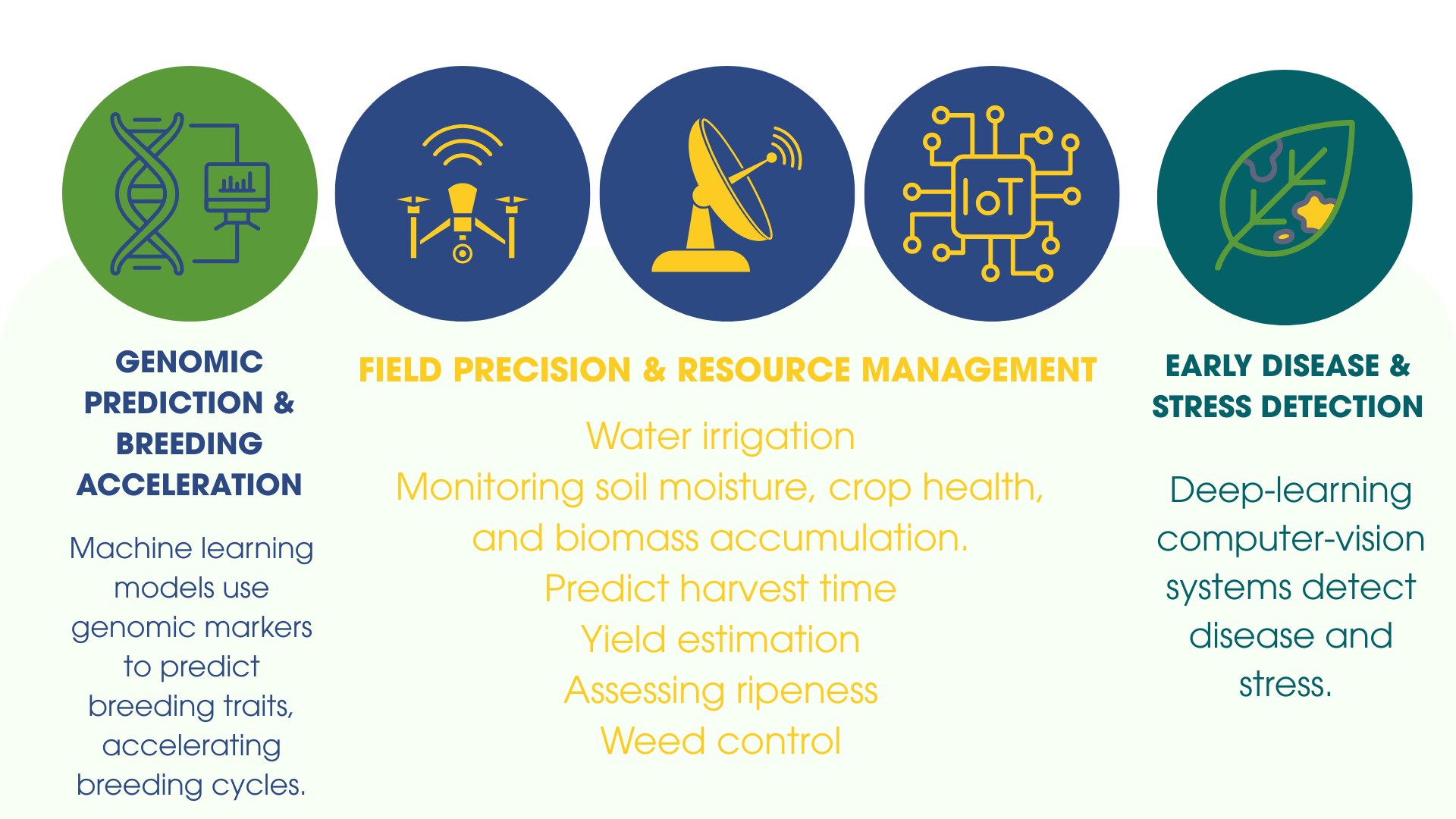
Monsanto (now part of Bayer)88 Lemieux, J. (2022) ‘From Pharma to Farm: Can CRISPR Feed the World?’, Genetic Engineering & Biotechnology News, 1 June. Available at: https://www.genengnews.com/topics/genome-editing/from-pharma-to-farm-can-crispr-feed-the-world/ uses AI and CRISPR gene editing technology to accelerate crop breeding99 Kock, M.A. (2022) Intellectual Property Protection for Plant Related Innovation: Fit for Future? Cham: Springer.. By analysing vast amounts of genomic data, AI algorithms identify genes associated with desirable traits such as drought resistance, pest resistance, and higher yields. AI helps streamline the traditional breeding process, enabling the development of genetically modified crops – including maize, wheat and soybean – that can thrive in diverse climates and resist diseases (Figure 2).
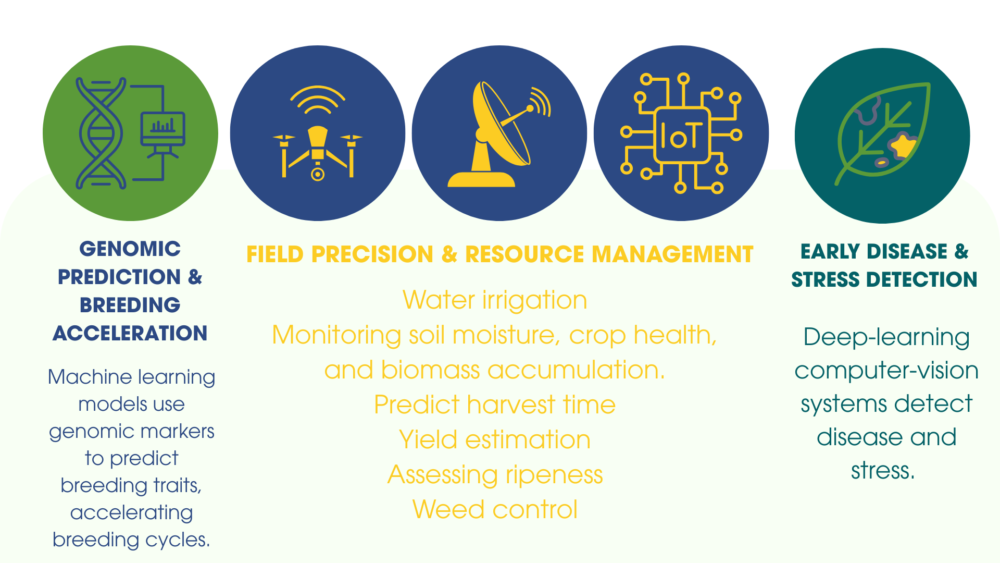
Figure 2. Contribution of AI in crop production
AI in the field: precision monitoring and resource management
AI‑enabled precision agriculture uses sensors, drones, satellite imagery, and the Internet of Things to monitor soil conditions and crop health at fine spatial resolution. In sugarcane – a major biofuel feedstock – UAV (Unmanned Aerial Vehicles)‑mounted LiDAR and multispectral sensors have predicted at‑harvest biomass at 2 m × 2 m resolution with moderate accuracy (peak R² ≈ 0.57) early in the season1010 Johansen, K., Raharjo, T., & McCabe, M. F. (2020). Fine-scale prediction of biomass and leaf nitrogen content in sugarcane using UAV LiDAR and multispectral imaging. International Journal of Applied Earth Observation and Geoinformation, 92, 102183. https://doi.org/10.1016/j.jag.2020.102183. These capabilities allow growers to anticipate biomass accumulation, adjust nitrogen fertilisation, and time interventions to improve both yield and feedstock quality.
The commercial impact is already visible: John Deere has deployed GPS‑guided tractors and AI‑driven analytics at large scale, with some systems projected to deliver up to 15% higher yields and 30–45% fuel savings through adaptive route optimisation and equipment monitoring1111 Farmonaut (2025) AI-Driven Precision Agriculture, Satellite Analytics, and Fleet Optimization. Available at: https://farmonaut.com. In 2024, the technology delivered an average 59% reduction in non-residual herbicide use across more than one million acres, saving an estimated 8 million gallons of herbicide mix, and by 2025 had scaled to over five million acres with customers reducing herbicide use by nearly 50% even under a season of elevated weed pressure. John Deere’s See & Spray platform uses boom-mounted camera sensors and computer chips for running AI models to perform real-time “green-on-green” and “green-on-brown” weed detection at operational field speeds up to 15 mph. In commercial row-crop applications – including maize, soybean and wheat – targeted spot-spraying achieved 77% to 90% herbicide reductions compared to traditional broadcast spraying booms, thus lowering operational costs and chemical exposure1212 John Deere (2025) Deere Customers Use See & Spray™ Technology Across 5 Million Acres. Moline, IL: Deere & Company. Available at: https://www.deere.com/en/news/.
Commercial deployments of the Ecorobotix ARA smart sprayer use six high‑resolution RGB and depth cameras paired with onboard edge‑computing processors running deep‑learning vision models. Operating in real time under field conditions, the system classifies crops versus weeds and activates micro‑nozzles to apply herbicide only to 6 cm × 6 cm target spots on individual weeds. Across field trials and commercial use in sugar beets, onions, and other vegetables, this approach has reduced total herbicide volume by roughly 70–90%.1313 Ecorobotix (2026a) ARA620 · AI‑Powered UHP Sprayer by Ecorobotix. Available at: https://ecorobotix.com/ara/,1414 Ecorobotix (2025) Nearly 3,000 onion missions reveal ARA sprayer’s herbicide savings. Available at: https://ecorobotix.com/en-us/blog/3000-onion-missions-reveal-herbicide-savings/,1515 Anne, C., et al. (2024) ‘Assessing the Ecorobotix ARA ultra-high precision spot-spraying system in real field conditions’, Frontiers in Environmental Economics, 3, p. 1435283. doi: 10.3389/fenvc.2024.1435283.
Beyond machinery, AI‑driven variable‑rate technology processes historical yield maps, real‑time soil nitrogen and moisture sensing, and weather forecasts to apply precise micro‑doses of fertilisers only where needed. For example, the Climate Corporation, a subsidiary of Bayer, uses AI to help farmers optimise irrigation. Through its Climate FieldView platform, the company combines weather forecasts, field data, and soil moisture levels to provide farmers with precise irrigation recommendations for crops such as maize, wheat and soybean1616 R. Birner, et al., Who drives the digital revolution in agriculture? A review of supply-side trends, players and challenges 43 (4) (2021) 1260–1285. (Figure 2).
Early detection of pests and diseases: halting progression at its tracks
Computer-vision systems analyse photographs or video of leaves and identify disease symptoms, pest damage or nutrient stress. Early detection allows farmers to intervene before disease spreads across a field and reduces the need for blanket pesticide applications. For example, deep-learning systems have been developed to detect diseases in maize and wheat using images captured by drones or mobile devices. A recent maize study integrated AI diagnosis with precision fungicide application for Southern Corn Leaf Blight, demonstrating how disease information can be linked directly to targeted crop protection1717 World Bank. (2025). Harnessing Artificial Intelligence for Agricultural Transformation. https://www.worldbank.org/en/topic/agriculture/publication/harnessing-artificial-intelligence-for-agricultural-transformation.
A concrete commercial example is Plantix, developed by the Berlin-based startup PEAT GmbH, which uses deep-learning image recognition to diagnose crop diseases, pests, and nutrient deficiencies from a smartphone photo. Since its launch in 2015, Plantix has been downloaded more than 10 million times and has answered over 100 million farmer queries. Independent field evaluations in India have confirmed that its diagnostic performance holds up under real smallholder farming conditions, not just in controlled lab settings1818 World Bank. (2025). Harnessing Artificial Intelligence for Agricultural Transformation. https://www.worldbank.org/en/topic/agriculture/publication/harnessing-artificial-intelligence-for-agricultural-transformation (Figure 2).
Challenges and future directions
Despite this progress, significant barriers remain. Data scarcity for non-food energy crops and the compositional heterogeneity of lignocellulosic biomass complicates modelling. High upfront costs for sensors, drones, and computing infrastructure limit adoption, particularly among smallholder farmers. Interdisciplinary fragmentation persists: agronomists, data scientists, and biorefinery engineers often operate with divergent definitions of feedstock quality, impeding the co-design of AI systems that serve the entire value chain. Ethical concerns regarding land-use competition between food and fuel, biodiversity impacts of monocultures, and the carbon footprint of AI computation itself require careful governance.
Looking ahead, three trends will probably shape AI’s role. First, federated learning—where collaborative models are trained across multiple farms without centralising sensitive data—promises to overcome privacy and fragmentation barriers. Second, the convergence of generative AI with synthetic biology is enabling closed-loop systems in which AI designs both crop genotypes and microbial consortia for optimised bioprocessing. Third, digital twins spanning farms and biorefineries will allow stakeholders to simulate entire production seasons, testing management scenarios for yield, quality, and sustainability before implementation1919 Cao, C., Zhuang, J., Wu, J.J. and Zhou, W. (2026) ‘Impact of Progress of AI on Circular Bioeconomy: Applications, Challenges, and Future Directions’, in Zilberman, D., Zhuang, J., Wesseler, J. and Khanna, M. (eds) Handbook of Circular Bioeconomy. Cham: Springer (Natural Resource Management and Policy, vol. 61), pp. 397–440. https://doi.org/10.1007/978-3-032-07112-5_18.