Harnessing AI for the Bioeconomy, Part 2: From Precision Fermentation to Manufacturing
Dr Konstantinos Drousiotis
Senior Research Analyst
The second article in the Harnessing AI for the Bioeconomy series from our Senior Research Analyst Dr Konstantinos Drousiotis looks at the benefits of AI in precision fermentation and where it’s value lies in linking decisions from the various facets of biomanufacturing.
Introduction
Unlike traditional fermentation, which uses wild or naturally selected micro-organisms to transform organic inputs and alter food profiles (e.g., yeast fermenting sugars into alcohol in beer), precision uses targeted genetic modification (e.g., recombinant DNA, CRISPR) to direct microbes to express specific, valuable substances, including food ingredients, enzymes, bioactive metabolites, pigments, and biofuels11Vinestock, T. et al. (2024) ‘Computer-aided chemical engineering research advances in precision fermentation’, Current Opinion in Food Science, 58, p. 101196. doi:10.1016/j.cofs.2024.101196.. Bioinformatics, molecular analyses, omics studies, kinetic modelling, bioprocess development, genetic engineering, and, more recently, the application of artificial intelligence (AI) are some of the disciplines and tools that are incorporated into this approach (Figure 1).
Developing a microbial strain that performs well in 1L laboratory cultures can take years of trial and error, and many promising strains still fail when scaled up. AI is now making a tangible impact by accelerating and de‑risking this process. In biomaterial discovery and optimisation, AI‑enabled Design–Build–Test–Learn (DBTL) cycles can be shorter by up to 40%, reducing total development times by more than 30%ii. This acceleration applies both to reaching a high‑performing strain at the 1L scale more quickly and to improving the likelihood that such strains will scale successfully, thereby cutting the number of costly scale‑up failures.
The benefits of AI in precision fermentation are not just in terms of automating individual functions, like screening for strains or logging data. Its value lies in linking decisions from the various facets of biomanufacturing: feedstock, strain development and the design of the enzyme; the control of the fermentation process, the separation in the downstream process, and finally to the techno-economic assessment that will determine whether or not a process is worth scaling22 Kim, J. Y., Yu, H. E., Kim, M. H., & Lee, S. Y. (2026). Beyond petrochemicals: Challenges and opportunities in industrial scale biomanufacturing. Nature Communications, 17, 4819.. The difference between a useful application of AI and a shallow one is ensuring that a systems view is taken33 Wang, Z-Z., Zeng, D-W., Zhu, Y-F., et al. (2025). Fermentation design and process optimization strategy based on machine learning. Biotechnology and Industry (bidere).
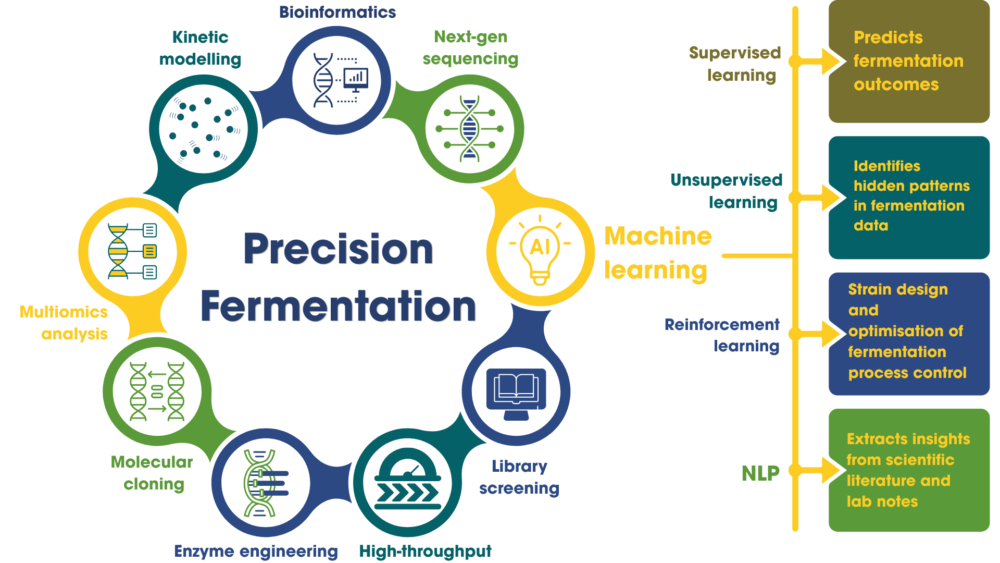
Figure 1: Disciplines and tools incorporated into precision fermentation
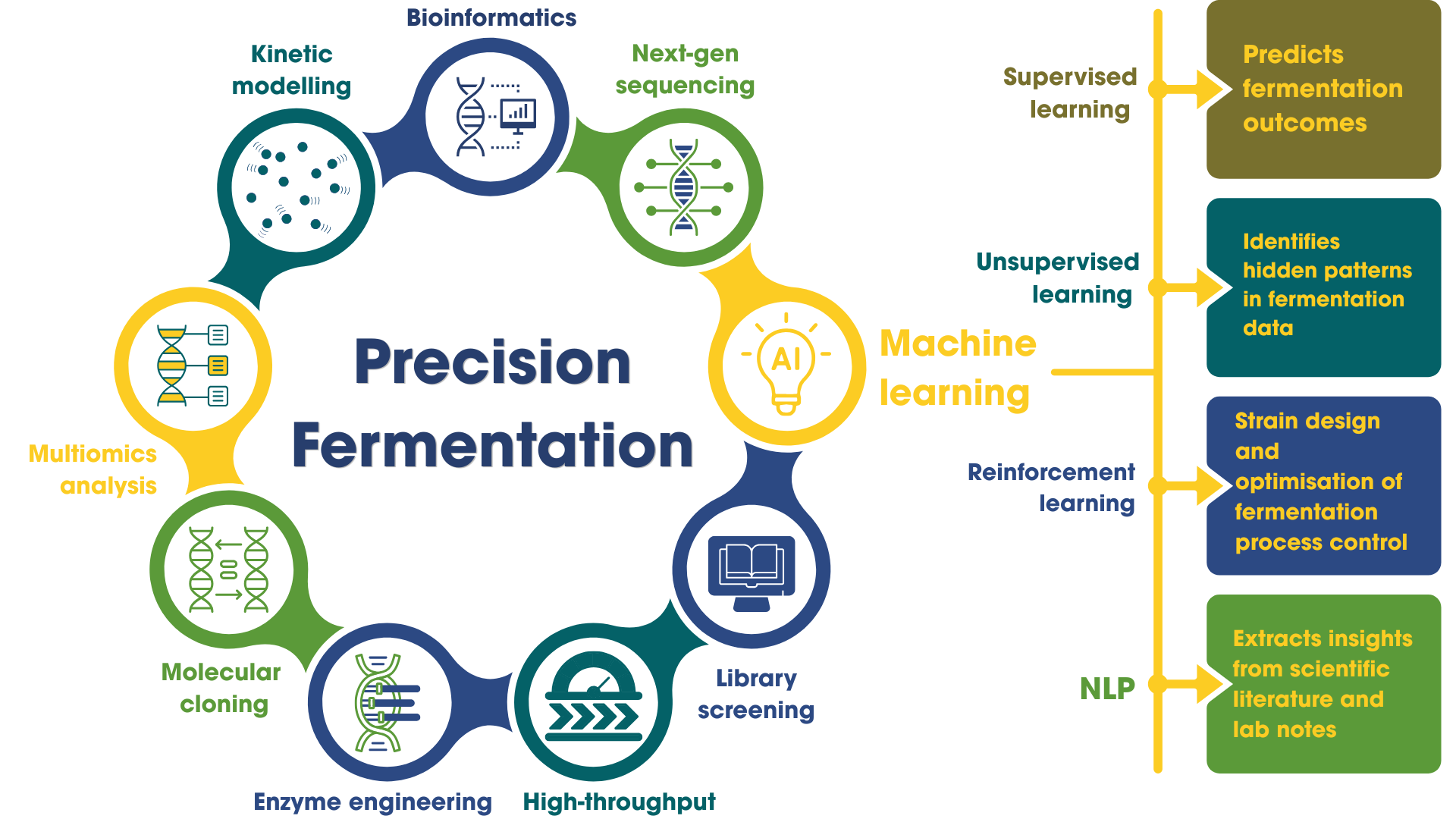
Developing improved organisms, quicker
Artificial intelligence is fundamentally transforming how microbial strains are designed and optimised for industrial fermentation, compressing development timelines that previously required months of iterative laboratory experimentation. For example, Basecamp Research partnered with consumer goods giant Procter & Gamble to deploy generative AI platforms like ZymCTRL and EDEN alongside large language models for deep genomic mining44 Basecamp Research and P&G partner to design high-performance enzymes with AI | P&G. By combining NLP and metagenomic data collected from extreme global environments, the partnership computationally designs high-performance, cold-water cleaning enzymes tailored for sustainable bio-manufacturing applications.
To embed these capabilities into the genomes of model organisms, AI is being integrated with CRISPR‑Cas9 gene editing. Tools such as DeepCRISPR55 Oyeniran, K.A. and Donaldson, L. (2026) ‘Artificial Intelligence in Microbial Biotechnology for food security: Current state and Challenges’, Frontiers in Bacteriology, 5. doi:10.3389/fbrio.2026.1921669. facilitate this synergy, helping to cut design–build–test–learn cycle times and improve design efficiency by up to 70%. Machine‑learning models are then used to optimise specific traits: for example, models that predict thermostability for industrial enzymes, and Random Forest classifiers that identify acid‑tolerant strains in fermented matrices (Figure 2).
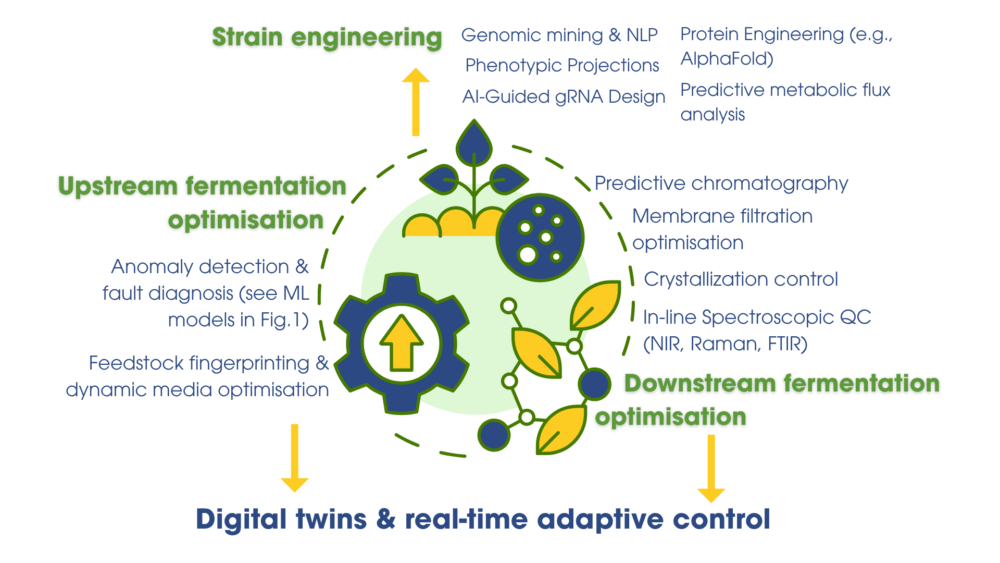
Figure 2
On a protein structural level, AlphaFold’s structural insights have aided enzyme engineering efforts at scale, helping researchers redesign enzymes to improve catalytic efficiency for biomanufacturing, while AlphaFold 3’s expanded capability to predict protein interactions with small molecules, RNA, DNA, and metal ions opens new possibilities for pathway engineering beyond single-protein design. At the commercial frontier, microbial engineering company Ginkgo Bioworks66 Resources | Ginkgo Bioworks Automation is designing millions of proteins and strains daily, screening over 15 billion compounds via AI and training models on hundreds of millions of protein structures. It’s February 2026 demonstration of a GPT-5-driven autonomous lab optimising cell-free protein synthesis represented a landmark in closed-loop strain development.
Multi-agent reinforcement learning approaches have demonstrated particular promise for strain design with published results showing faster and more reliable convergence toward industrially attractive production levels, though a critical challenge identified across multiple publications remains the persistent laboratory-to-industrial scale-up gap.
From lab to the factory: the fittest make it successfully
Many microbial cell factories that perform well in the laboratory lose productivity and cost competitiveness at industrial scale. AI is being positioned as a key enabler for bridging the gap between lab-scale metabolic engineering and commercially viable biomanufacturing.
In large-scale bioreactors, where nutrient gradients, temperature swings, and dissolved oxygen fluctuations create a persistent “scale-up effect”, AI and machine learning models (Figure 1) can ingest real-time sensor streams to model nonlinear interactions and adjust parameters before deviations become failures. This capability underpins the emerging concept of the bioprocess “digital twin” (Figure 2) – a computational replica running in parallel with the physical fermenter, ingesting live and older data and proposing or executing closed-loop corrections, in a way that output (the correction) feeds back into the input (the process conditions) to maintain optimal conditions. Market data confirms the rapid commercial adoption of these technologies: upstream bioprocessing contributed 35-50% of the bioprocess digital twins market share in 202577 https://www.snsinsider.com/reports/bioprocess-digital-twins-market-10711 88 Global Bioprocess Digital Twin Market Size, Share 2026-2035, with Sartorius AG advancing digital capabilities through advanced analytics and automated workflows that improve reproducibility between manufacturing campaigns.
As an example, an AI system identified glucose concentration as the critical control variable for α-amylase production by Aspergillus niger, then automatically maintained it in the optimal range, delivering a 46% increase in enzyme titre, 28 fewer process hours, and concentrations surpassing previous levels99 Adebiotech / Université de Lille.. Advanced Fermentation Technology 2026 (AFT) — Official Program. asso.adebiotech.org. 2026.. LG Chem has also employed this approach in the production of 3-hydroxypropionic acid (3-HP). The simultaneous real-time monitoring of glycerol and 3-HP concentrations enabled an optimised feeding strategy which significantly reduced glycerol accumulation and increased 3-HP yield. This improved downstream purification with decreased processing time and cost1010 Kwon, Y. et al. (2025) ‘Real-time feed-rate optimization in 3-hp fermentation using digital twin technology’, Industrial & Engineering Chemistry Research, 64(43), pp. 20497–20505. doi:10.1021/acs.iecr.5c02916. . The Genesis Mission, an effort to accelerate AI in the biological sciences, specifically biotechnology and biomanufacturing, received £217 million from the U.S. Department of Energy in March 2026. The claimed objectives are to create shared “AI-ready” biological databases, shorten R&D cycles, and create AI-powered digital twins for scale-up1111 U.S. Department of Energy.. DOE announces $293 million for the Genesis Mission to support AI research and development in biosciences. globaltradealert.org / thelconsulting.com. 2026..
From fermenter to formulation: AI in downstream purification and quality assurance
Artificial intelligence is transforming downstream fermentation optimisation, elevating inline spectroscopic monitoring from a supporting analytical tool into a central enabler of closed-loop quality control and purification efficiency. In a reported commercial GMP application, Chinese Cytiva’s GoSilico platform was used to create a mechanistic digital twin of a chromatography process, generating more than 3,000 virtual simulations from only five calibration experiments and achieving an 11% improvement in product recovery1212 Cytiva 攜手永昕生醫,以數位孿生與創新製程引領台灣 CDMO 邁向全球 | GeneOnline News. Similar hybrid-model platforms, such as Novasign’s AI-powered digital twins, are being developed in Austria to support harvest, membrane filtration and chromatography by predicting operating conditions, process performance and potential deviations before they occur1313 https://novasign.at/post/autonomous-continuous-biomanufacturing-closing-the-gap-between-process-development-and-production/.
As an example of a holistic AI-assisted improvement of biomanufacturing is New Wave Biotech and iMEAN’s end-to-end platform: ML-enhanced downstream optimisation across 16 unit operations coupled with genome-scale metabolic modelling gave an >8 fold increase in yield, 55% lower unit costs and 92% fewer experiments1414 https://www.greenqueen.com.hk/new-wave-biotech-imean-upstream-downstream-biomanufacturing/.

Valorising AI in manufacturing
Effectively valorising “AI in fermentation” lies in the implementation, not of a single capability, but a stack of distinct interventions generative enzyme design, pathway prediction, dynamic process control, and digital-twin-based scale-up modelling each addressing a different point of commercial risk. A company’s competitive position depends less on whether they have adopted AI in the abstract, and more on which specific bottleneck they have targeted: strain development speed, fermentation yield, or the scale-up gap between laboratory success and industrial reality. Understanding that distinction and knowing which bottleneck is actually constraining the process economics, is where the opportunity lies.
Conclusion
Across the fermentation value chain, from generative enzyme design and CRISPR-guided strain engineering, through digital-twin-enabled scale-up, to AI-optimised downstream purification, the common thread is not automation of individual steps but the closing of feedback loops that were previously slow, manual, and disconnected. As these tools mature, the long-standing gap between laboratory success and industrial scale-up is narrowing. For advisors and manufacturers alike, the opportunity now lies less in tracking AI capability in the abstract, and more in diagnosing which link in the biomanufacturing chain, upstream design, process control, or downstream recovery, will unlock the greatest commercial value.