Biomass, Shipping, Power and BECCS
Caroline Randall
Marketing Manager
UK power producer Drax is celebrating its 50th anniversary, the company has transitioned from coal-based power generation to being the UK’s largest producer of renewable electricity, and through its Drax Power Station the operator of the UK’s largest single source of renewable electricity generation.
Drax currently operates or is developing 18 pellet production facilities across North America, with a combined nameplate capacity expected to exceed five million tonnes of output upon completion. This transatlantic model, encompassing biomass production in North America and power generation in the UK, necessitates a complex and extensive supply chain supported by significant logistics infrastructure.
For example, as part of its 50th anniversary celebrations, a new vessel named the M.V. Ultra Yorkshire, made its first transatlantic voyage from the US to the UK. The vessel, operated by dry bulk logistics business Ultrabulk, transported its cargo of over 29,000 tonnes of biomass pellets from the Port of Greater Baton Rouge to the Port of Liverpool. The pellets are subsequently transported by rail from Liverpool to Drax’s power station in Yorkshire.
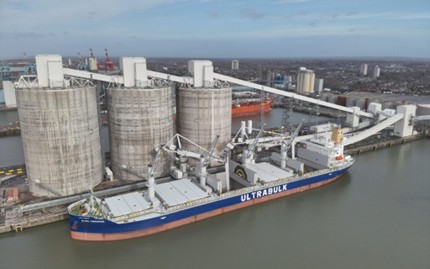
M.V. Ultra Yorkshire, Handymax carrier. Source Drax
Whilst the global energy system remains dependent on fossil fuels, a critical but often underexamined component of this system is the vast volume of shipping and fuel required to transport these resources. Oil, coal, and liquefied natural gas (LNG) are frequently moved across continents via maritime routes, forming one of the largest bulk transport networks in the world. The transport of fossil fuels accounts for over one-third of maritime transport volumes with around 16% being crude oil shipping, 11% coal transport, and 5% for the shipping of gas. Globally, approximately 18,000 vessels are occupied in the of transport fossil fuels. Around two billion tonnes of crude oil are transported annually with a further one billion tonnes of oil products shipped. The annual shipping of coal also exceeds one billion tonnes.
Shipping fossil fuels is inherently carbon-intensive. Maritime transport relies predominantly on heavy fuel oil, one of the most polluting petroleum products. As a result, the shipping sector is responsible for approximately 2–3% of global greenhouse gas (GHG) emissions.
To mitigate shipping emissions M.V. Ultra Yorkshire’s recent journey was fuelled using Hydrotreated Vegetable Oil (HVO) B100 fuel. Through switching from standard maritime fuels, like VLSFO or ULSGO, to HVO it was estimated that the vessel reduced its carbon emissions by around 90%.
Although this represents a significant improvement in carbon emissions it creates a new demand for valuable and limited HVO biofuel.
Transitioning the power system to renewable electricity generated domestically from wind and solar offers a possible solution. Renewable energy sources such as wind and solar are inherently local or regional, reducing the need for long-distance fuel transport. Electricity generated from renewables can be transmitted via grids rather than shipped physically, thereby eliminating the emissions associated with maritime logistics. Electrification of end-use sectors such as transport, heating, and industry displaces fuel demand and, consequently, the need for large-scale shipping.
Importantly, large-scale biomass power generation holds one enticing possibility not available through other generation technologies such as wind and solar; the potential to deliver negative emissions through carbon capture and storage, referred to as Bioenergy with Carbon Capture and Storage (BECCS). Throughout their growth, plants sequester CO2 from the atmosphere and therefore as long as this carbon is not released back to the atmosphere when they are combusted e.g. through capturing the CO2 released during power generation, then the system results in the removal of CO2 from the atmosphere – a negative emission.
According to Supergen Bioenergy, studies find that BECCS has the potential to deliver negative emissions but managing the life-cycle emissions of the bioenergy used is crucial to achieving a carbon negative result. They point out that limiting the CO2 emissions from growing, transporting, and processing biomass is essential. It is therefore clear that maximising the benefits of BECCS means minimising transport emissions and in the case of transatlantic maritime shipping this means the increased use of limited low carbon biofuels such as HVO or biomethanol. HVO is produced from vegetable oil and while it can give ‘used cooking oil’ (UCO) a second lease of life the volume of available vegetable oil is constrained by sustainability concerns. There is also significant demand for vegetable oil to produce aviation fuel further limiting accessibility as a marine fuel. Biomethanol is produced via the gasification of biomass. It can be derived from a wide range of biomass residues providing the potential for higher production volumes than HVO, however the scale of maritime shipping means that satisfying overall fuel demand remains a significant challenge.
However, the ability of BECCS based on forestry products to deliver meaningful negative emissions has been questioned, most recently by Prof. Timothy Searchinger and co-workers. Their modelling of the use of wood in BECCS systems indicated that BECCS is unlikely to generate negative emissions within 150 years and is likely to produce higher emissions for decades in comparison to power generation using natural gas without carbon capture.
Although much of the controversy and contention over the potential of forestry biomass based BECCS to deliver negative emissions centres on the concept and modelling of carbon debt (the time taken for a forest to replace extracted biomass), emissions from transport cannot be ignored, as demonstrated by Drax’s use of HVO.
In conclusion, while the global shipping of fossil fuels is a major contributor to GHG emissions, the transition to renewable electricity offers a pathway to substantially reduce both energy-related emissions and the need for carbon-intensive transport. Furthermore, the use of imported biomass for power generation as BECCS must be approached with caution, as its reliance on large-scale biomass supply chains introduces logistical and environmental challenges that can diminish its effectiveness. A comprehensive power decarbonisation strategy should prioritise domestic renewable electricity from wind and solar, while critically evaluating the full lifecycle impacts of supplementary technologies such as BECCS.
Further reading: Biomass cannot supply everything: New report calls for strategic prioritisation of limited resources, https://www.alderbioinsights.co.uk/news-and-insights/news/biomass-cannot-supply-everything-new-report-calls-for-strategic-prioritisation-of-limited-resources/
Sources
Drax,(2026) Ultra Yorkshire makes first transatlantic voyage delivering biomass pellets to support UK energy security, https://www.drax.com/uk/press_release/ultra-yorkshire-makes-first-transatlantic-voyage-delivering-biomass-pellets-to-support-uk-energy-security/
Fricaudet, M., Prakash, V., Sohm, S., Smith, T. and Rehmatulla, N. (2024) Fossil fuel carrying ships and the risk of stranded assets, London, UK. https://www.ucl.ac.uk/bartlett/sites/bartlett/files/fossil_fuel_carrying_ships_and_the_risk_of_stranded_assets_final.pdf
Searchinger, T.D., Peng, L., Russi, D. et al. Decades of increased emissions from forest-fuelled BECCS. Nat Sustain (2026) https://doi.org/10.1038/s41893-026-01817-8.
Supergen Bioenergy, (2023) Myth-busting paper on Bioenergy with Carbon Capture and Storage, https://www.supergen-bioenergy.net/output/myth-busting-paper-on-bioenergy-with-carbon-capture-and-storage/
United Nations, (2025) Review of maritime transport 2025, https://unctad.org/system/files/official-document/rmt2025ch1_en.pdf.
United Nations Trade and Development (UNCTAD), (2025) Seaborne trade data, https://unctad.org/news/shipping-data-unctad-releases-new-seaborne-trade-statistics