DESNZ: Methane Emissions from Anaerobic Digestion (MEAD) 2.0
Caroline Randall
Marketing Manager

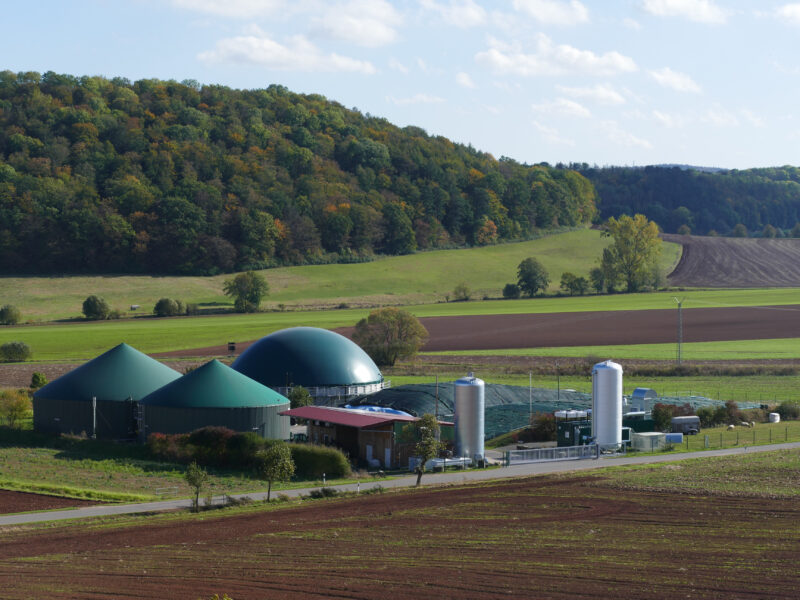
The Department for Energy Security and Net Zero (DESNZ) has today (23rd November 2026) published the findings of the Methane Emissions from Anaerobic Digestion 2.0 (MEAD 2.0) project. This study was commissioned following a previous government-backed review1 that found variation in the levels of methane losses across AD plants in the UK. MEAD 2.0 then set out to understand in more detail where and why methane escapes during the AD process, how losses can be prevented through better plant design, operation and maintenance, and what can be done about methane that continues to form in digestate, the material left after digestion.
The team at Alder BioInsights working on MEAD 2.0 was led by Lucy Hopwood, Director; David Vaughan, Managing Consultant; and Sophie Mason, Senior Consultant. The team was supported by colleagues at Bohr Ltd. and Marches Biogas who carried out field work and lab trials on behalf of the project.
Bohr Ltd. carried out on-site testing at 8 operational UK AD plants. The team tested individual equipment on-site, including digester roofs, valves and pipework, to locate potential methane leaks, and investigated how much methane was present in the gas discharged from biogas upgrading equipment. A key finding from Bohr’s research was that half of the digesters assessed showed evidence of methane leakage to varying levels, and that leaks from pressure relief valves (PRVs) were found as a common source at sites assessed. Methane concentrations in the off-gas released by biogas upgrading units (BUUs) ranged from negligible to ~9%, highlighting how upgrader type, configuration and operating conditions can also influence methane losses. A key aim of this work was to highlight areas on-site where AD operators should check for leaks during routine inspections, and to provide insights on why methane leaks may occur and how to mitigate them going forward.
Marches Biogas investigated methane release at the back end of the AD process, from digestate during storage. A review of existing literature outlined that the most effective way to prevent methane from escaping at this stage is to use a gas-tight storage cover to capture residual gas, a practice already widely used at AD plants. Marches then carried out laboratory trials to examine whether treatments such as aeration, pasteurisation and changes in pH could limit further methane production, and thus, emissions to the atmosphere. Of the approaches tested, adjusting the pH was the only method that stopped methane generation across all digestate types assessed under the trial conditions. Aeration, pasteurisation and extended digestion time also suppressed methane production. However, further work is needed to establish how these measures may perform at commercial scales.
Alder BioInsights compiled the results of the research carried out by Bohr and Marches, and incorporated a desk-based review of published research on fugitive methane emissions at AD sites; analysed the UK’s AD market in order to ensure that UK specific insights were considered; and interviewed AD operators, installers, maintenance engineers and technology suppliers to capture industry experience throughout the project.
For those who design, operate and maintain AD plants, the two deliverables published as part of this project – the MEAD 2.0 Final Report and accompanying Good Practice Guide for Point Source Emissions – provide a practical basis for reducing methane losses. From designing new plants so that roof seals are accessible for inspection, to checking that repairs have stopped a leak. Such decisions help operators to retain more of the gas that they produce, and work to protect the climate benefits of anaerobic digestion as a technology. For further information about the research carried out, or to find out more about how Alder BioInsights supports the anaerobic digestion sector, please contact:
- Lucy Hopwood (l.hopwood@alderbioinsights.co.uk)
- Sophie Mason (s.mason@alderbioinsights.co.uk)
- David Vaughan (d.vaughan@nnfcc.co.uk)
The Good Practice Guide does not change existing Green Gas Support Scheme (GGSS) or Non-Domestic Renewable Heat Incentive (NDRHI) requirements. However, scheme applicants and participants are encouraged to consider its recommendations when building and operating their plants. They should continue to follow the schemes’ existing greenhouse gas calculation and reporting requirements.